the JULIANA NZITA STORY
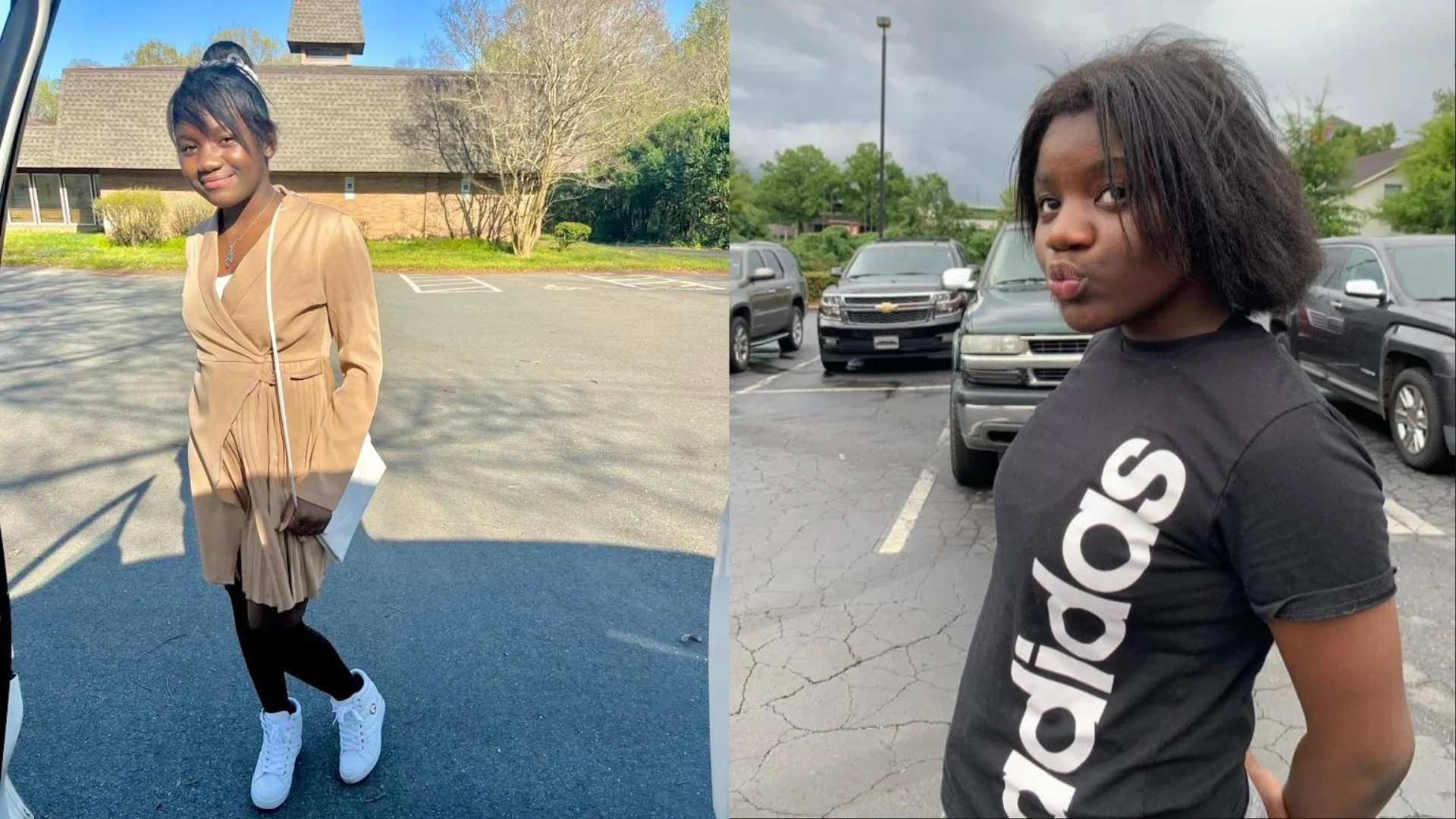
Written by Jeremiah Patterson
Explicit Warning: This article features explicit and graphic imagery, words, and sentiment. This will be difficult and uncomfortable to read, but it’s imperative that you do. Please watch the full video special report on “The Juliana Nzita Story” before or after reading this. The video report will include several interviews and field footage that you will not see in this article.
Historical Context:
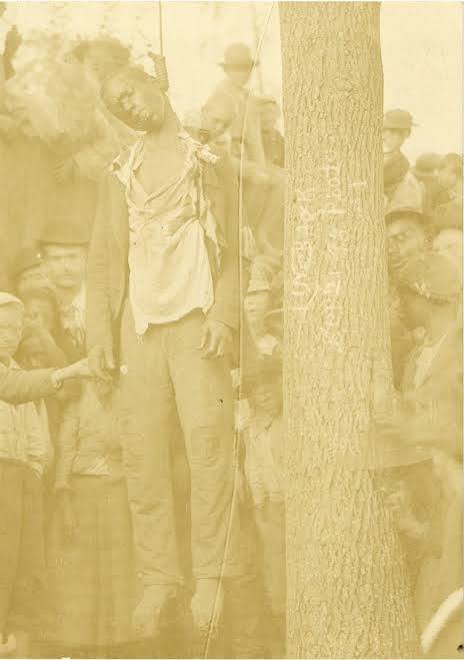
The Lynching of Thomas Smith In 1893 (Roanoke, Virginia)
Today, when you think of a Black person being lynched. This image comes to mind. A Black body swinging from a tree as a means of racial terror. However, that is just one form of lynching. Other forms include being burned at the stake, being shot to death, mercilessly beaten, bombed, etc. Lynching has never ended in the United States, it is still happening. The government just stopped documenting them and police departments consistently labeled them “suicides” and “accidents”.
According to The Equal Justice Initiative, there were 6,500 documented lynchings from 1865 to 1950. Many were never recorded. Out of the nearly 7,000 victims, 173 of those lynchings were in the state of North Carolina. Two of them were recorded in Charlotte, North Carolina. The Charlotte Mecklenburg Remembrance Project documents and recounts these stories.
On Friday, August 22, 1913, The Charlotte News and The Evening Chronicle reported, “Frantic Negro Shot Officer/Policeman Wilson Probably Fatally Wounded by Cocaine Fiend.” By using such vitriolic and defamatory rhetoric, the white newspapers framed the Black man as “dangerous and drugged up” to justify violence.
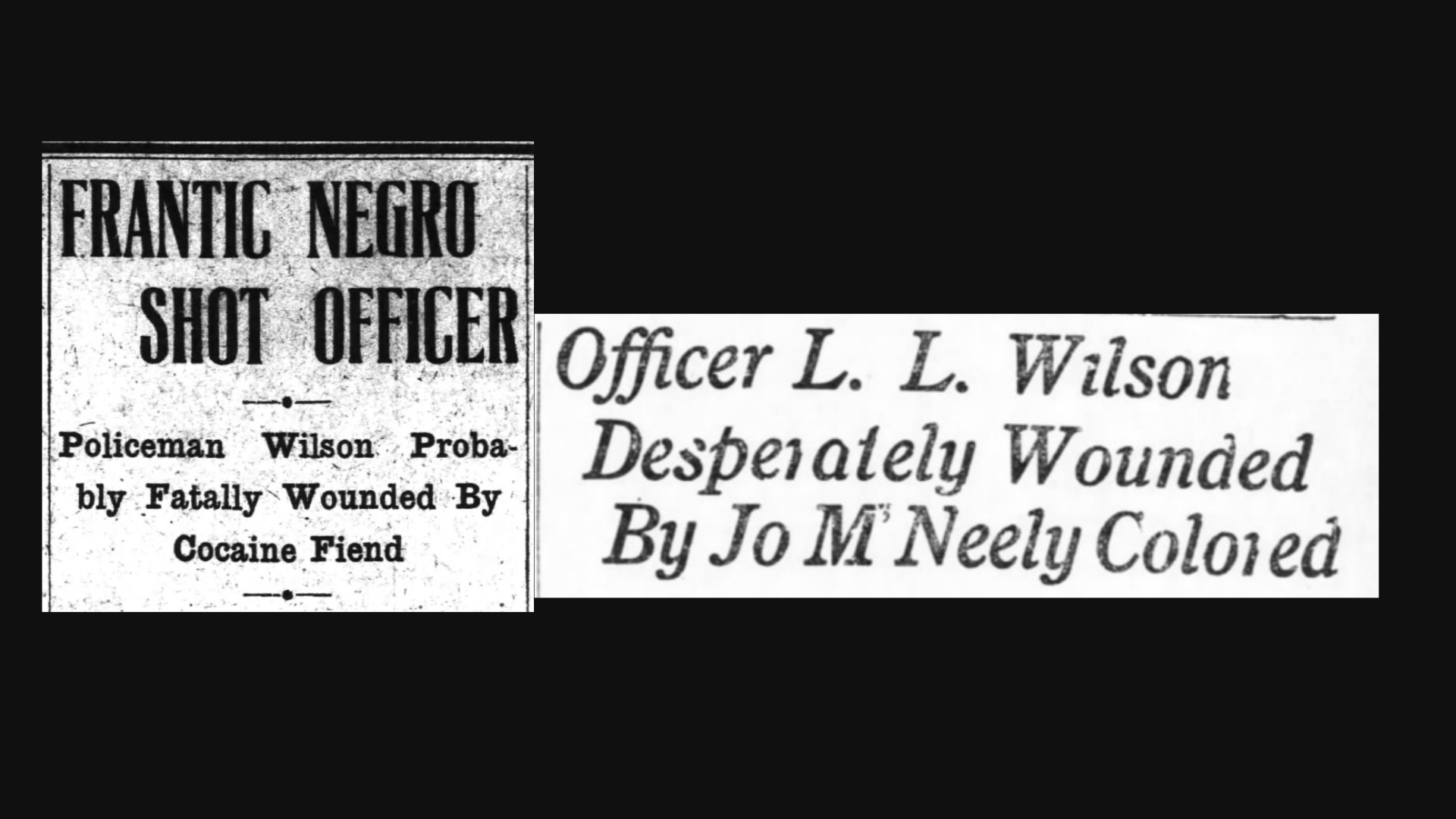
Courtesy of The Charlotte Mecklenburg Remembrance Project
According to stories that were unverified, the newspapers erroneously reported that a negro man had been brandishing a weapon, and shooting at everyone in sight. No one reported being hit or wounded.
Subsequently, Police Chief Horace More sent Officer Wilson, a white male, to go to the scene. He said this might be a good chance for him to use his new gun. Wilson said he was ordered to “go out and arrest a cocaine-crazed negro.” No evidence supported that racist remark. McNeely was not on any drugs. Officer Wilson arrived at the scene and was allegedly shot at close range by McNeely. Wilson returned fire, striking McNeely and then clubbing him with a blackjack.
The white newspapers such as the then Charlotte Observer Daily, now The Charlotte Observer, proceeded to stoke racial violence by implying that the white people in Charlotte were weak. The paper reported that Mecklenburg County, “has never had a lynching in its history and it never will have one. If a cocaine-crazed negro had ruthlessly shot an officer and attempted to kill other persons in many communities, serious race trouble would undoubtedly have followed. In Charlotte, however, the races live together in peace.”
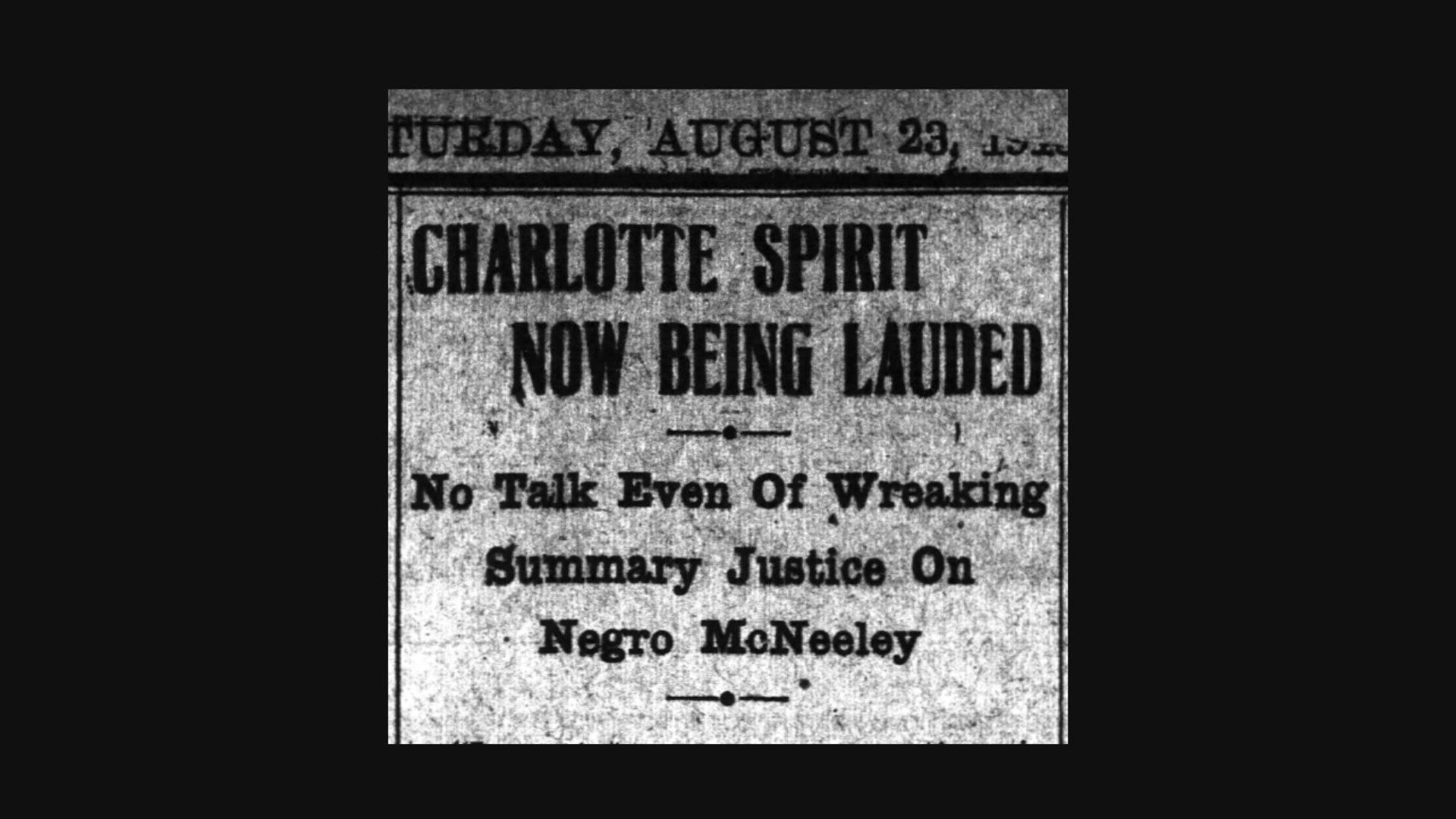
Courtesy of The Charlotte Mecklenburg Remembrance Project
This is an unmitigated declaration of violence. The paper also reported that McNeely would be moved to jail shortly. The following day, Charlotte’s white newspapers published two additional inflammatory reports, asserting that McNeely had been “very imprudent” to police officers. The reports said McNeely disparaged officers and ordered them to tend to him aggressively. None of this was true.
The papers continued to report that Officer Wilson wouldn’t live, but he made a full recovery. That didn’t matter. The damage was done and the call to violence became mandatory. The Sheriff received several calls warning him about inevitable violence, but he later claimed that he had no warnings.
The Sheriff failed to alert the police chief, whose department had custody of McNeely, and around 1 AM, a crowd emerged in front of The Good Samaritan Hospital. The police station is only less than a mile away, so there would be plenty of time to prevent this mob from attacking the hospital, but they do nothing. The group then storms the hospital, grabs Joe McNeely, strips him of his nightshirt, and drags him naked down the stairs of the building and into the streets.
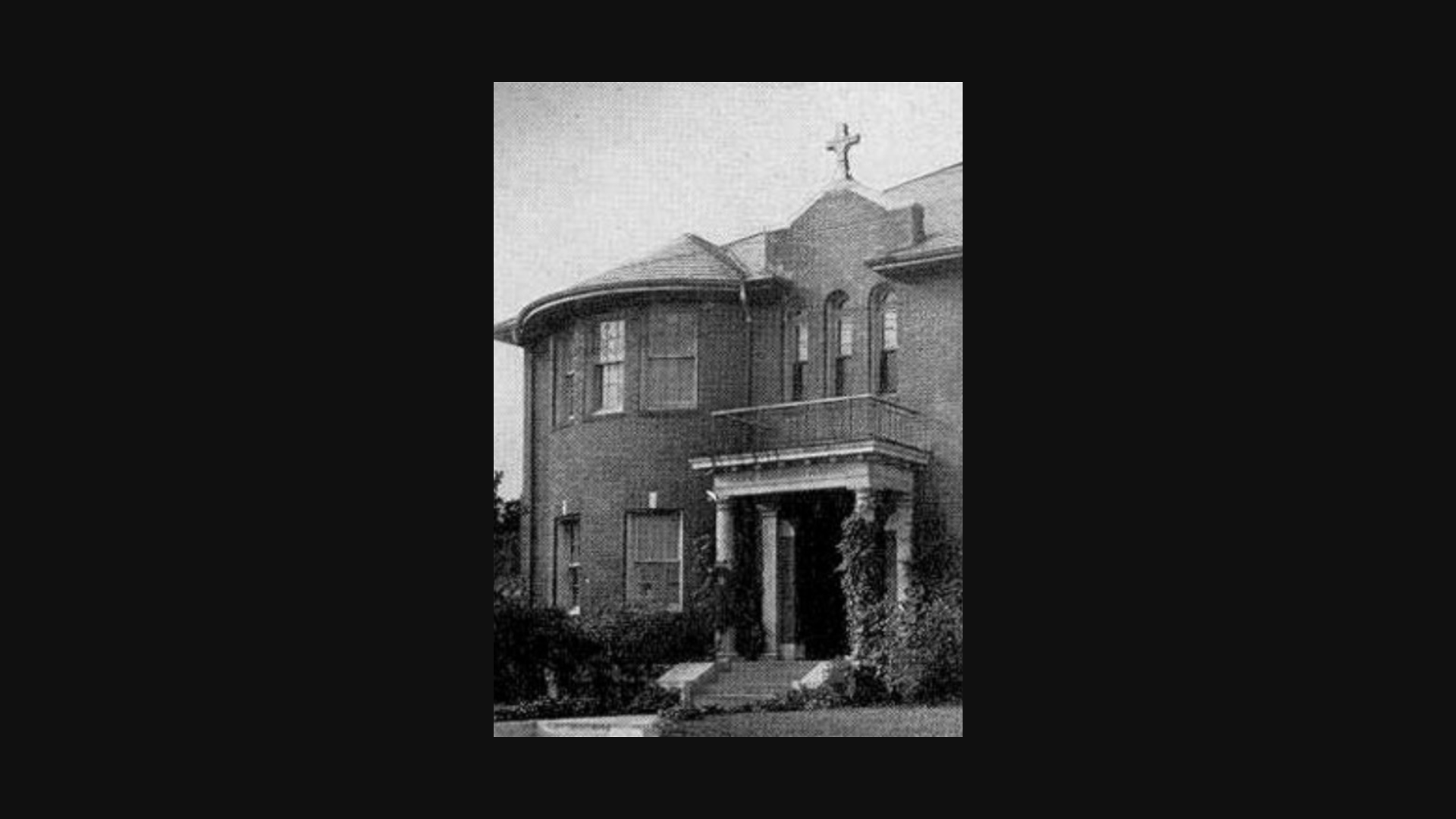
The Good Samaritan Hospital (Courtesy of The Charlotte Mecklenburg Remembrance Project)
The group of white domestic terrorists then fire multiple shots. Joe fell to the ground, still alive and breathing as the crowd disperses. There were 14 bullet holes in his body. Instead of police taking him back into the hospital for urgent medical attention, they brought him to the police station, where he bled out, and died at 5 AM. There were various calls for justice to find the killers who participated in the violence.
“When the splendid name of such a county as Mecklenburg is stained with blood, we are stricken with horror. And gentlemen, there walks today on your streets 35 men, according to the accounts, who are actual murderers. What are you going to do about the horrible crime that has been committed in this city this morning, gentlemen of the grand jury? Why would a mob commit such a crime? Because they feel assured of protection and of safety from the hands of the law.”
~ words from Judge T.J. Shaw, who commenced a grand jury in
Mecklenburg AFTER THE LYNCHING.
Judge Shaw also criticized the police for failing to protect Joe. Police never conducted a proper investigation or searched to find the perpetrators. Considerably, because they themselves were also complicit in that incredulous and despicable racial violence. Joe McNealy was 22 years old when he was lynched in Charlotte, North Carolina. Still to this day, he has not received justice. The building where the white supremacists dragged him from no longer exists, because it was torn down.
81 years later, construction began at that site for a new sports stadium in Charlotte. Two years later, the Bank of America Stadium officially opened in 1996, in Charlotte, North Carolina, on the grounds where 22-year-old Joe McNeely was lynched in 1913. That’s how the United States erases the memory and history of racial terrorism.
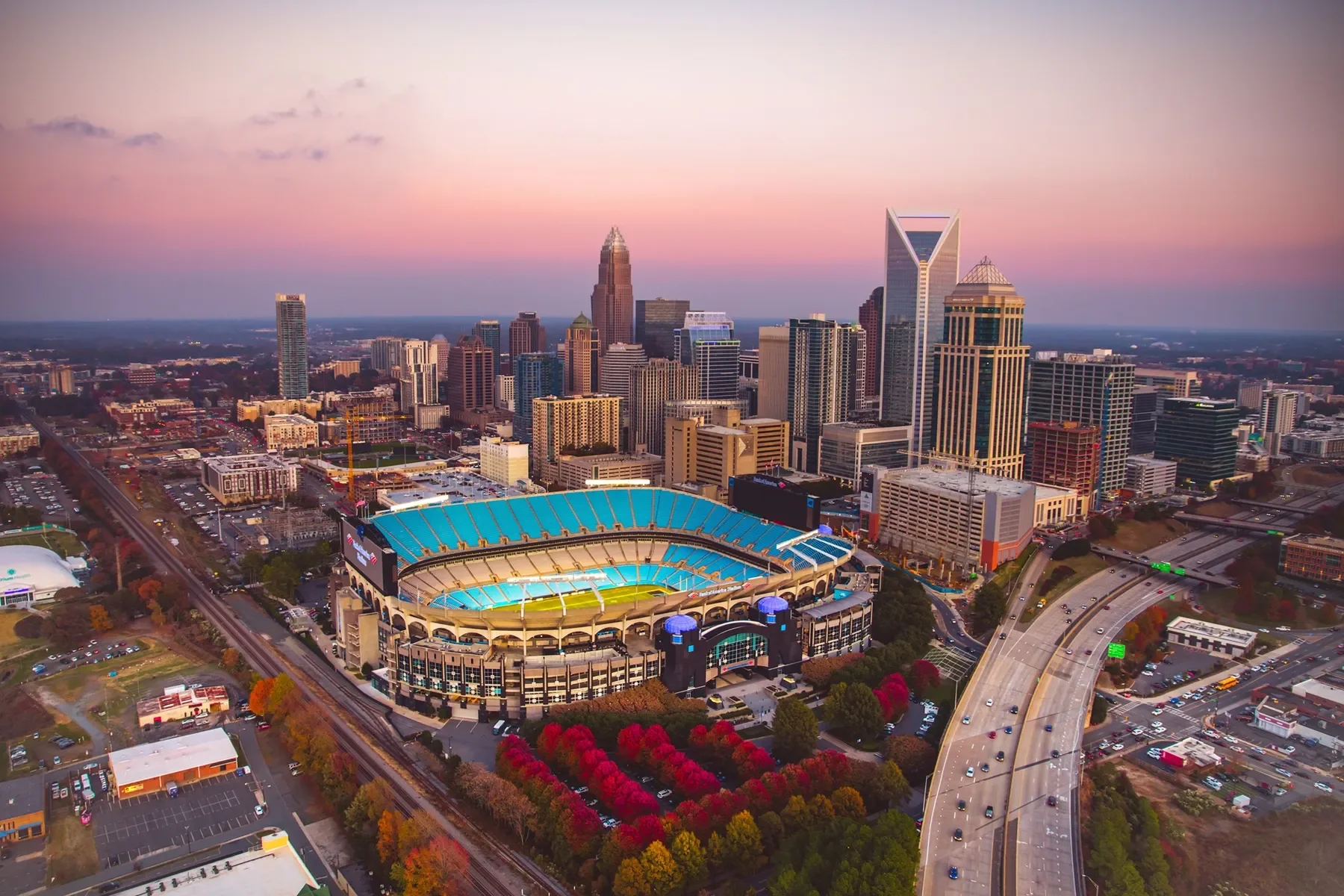
Bank of America Stadium (Charlotte, NC)
The current Bank of America Stadium also covers up the historic Black neighborhood and hospital that once occupied those grounds.
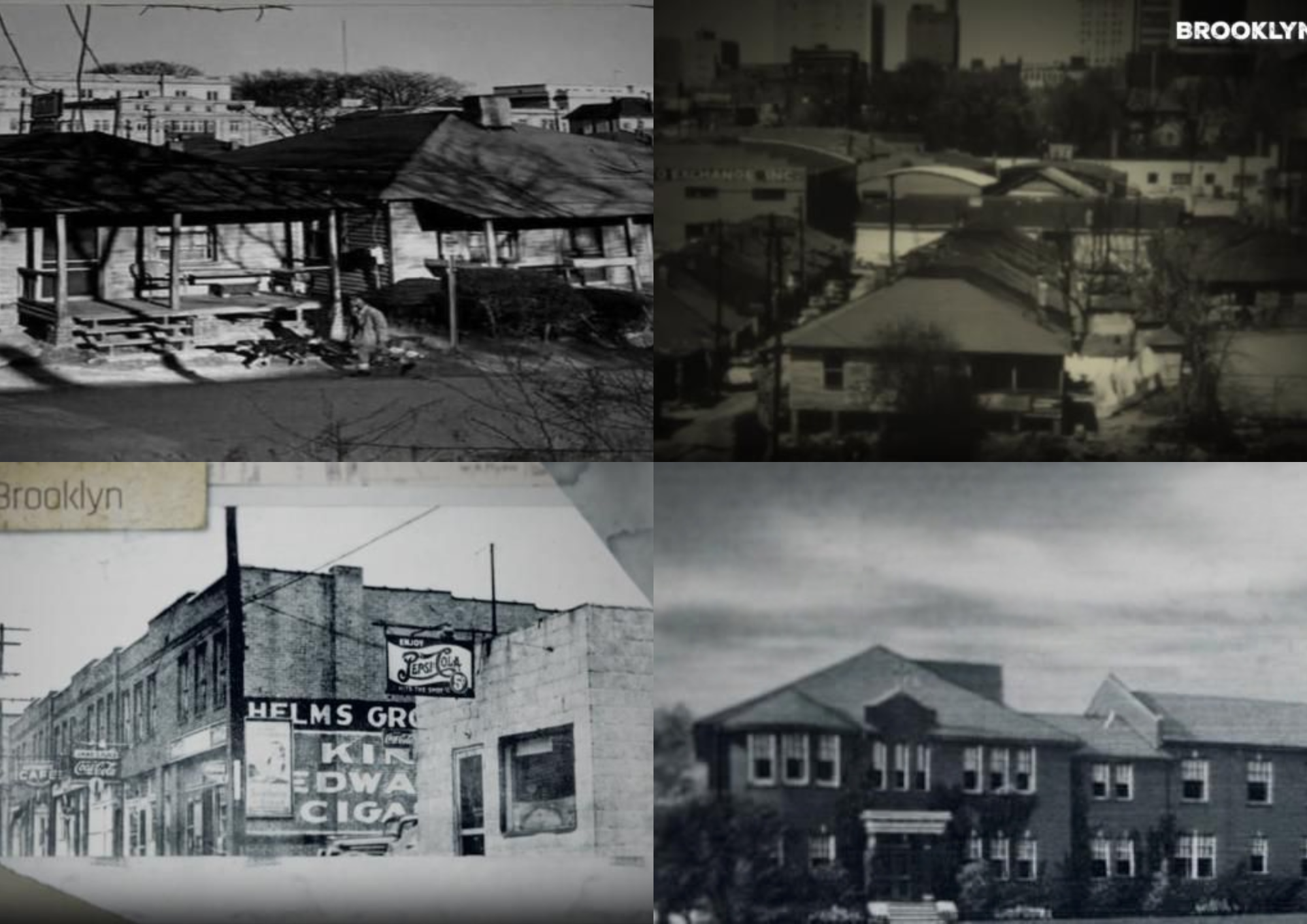
Historic Black Charlotte
Charlotte’s second documented lynching was in 1929, when a 22-year old Black man named Willie McDaniel was also lynched in the city, after inquiring about him & his wife’s compensation for labor. During my investigative trip to Charlotte, I visited the site of his lynching. Please watch the full video report to see this footage.
The Juliana Nzita Story:
Juliana Nzita, a 16-year-old Black Congolese teenage girl, was found dead, hanging from a tree on May 8, 2026. Her body was discovered on the grounds of a Black church, the United House of Prayer for All People. Juliana and her family attended church, but had no connection to this one. The church where she was found is a 20-minute walk from her home.
In the image obtained by TJPS NEWS, Juliana’s body is standing up, her feet touching the ground, and the rachet strap around her neck is tied to a tree trunk twice her height. She was wearing a dark jacket, black pants, and sandals. According to police, who spoke with the family, the blue chair next to her is from the family home.
Juliana struggled with her mental health and severe bullying at school, says an uncle who spoke with The Charlotte Observer.
Prior to her death, she had been missing for several days, beginning May 5th, 2026, according to reporting by The Charlotte Observer. Juliana’s body was found on a Friday afternoon, and by Monday, May 11, 2026, the medical examiner ruled her death a suicide. The Charlotte-Mecklenburg Police closed the case four days later on May 15, 2026. You can view the police report that I obtained from CMPD.
In an investigative series, Investigative reporters Maveah Griffith and Caitlin McGlade, found that police never recovered Juliana’s cellphone, no one from CMPD contacted the man who found her body, and authorities failed to do an autopsy. Police said a thorough inspection of the body was performed. The church, which sits on 21 acres of land, has security cameras and police reportedly reviewed footage, but said that no relevant footage was captured.
CMPD also said in the email to The Charlotte Observer that a thorough physical examination revealed no defensive wounds and no signs of physical or sexual assault, that there was no evidence indicating foul play, and that a tree limb had broken during the incident. According to police, the limb could have affected how Juliana’s body was positioned when she was found.
Her family and members of the predominately Black church where her body was discovered question the conclusion that she died by suicide. Mathy Nzita, one of Juliana’s uncles, does not believe his niece hung herself. He told The Charlotte Observer logistically, it seemed too difficult for her. Mathy also questioned why police didn’t truly investigate or conduct an autopsy.
Juliana’s family acquired their own autopsy and independent review, which will include DNA analysis, according to Jill Cohen Jefferson, a prominent Civil Rights Attorney, who’s representing the family.
Jill Cohen Jefferson is known for her renowned “A Crimson Record”, an investigative report on modern day lynchings.
The Charlotte Observer found that some of Juliana’s clothes were not returned to her family. Natasha Pratt Harris, a criminologist and Professor at Morgan State University in Baltimore, referred to this finding as “suspicious”, when speaking to The Charlotte Observer. She added, “If it’s a murder, you need to keep that evidence so you can use that in court.”
According to Attorney Jill Cohen Jefferson, it’s unclear if the family has received all of Juliana’s clothing. There are many details in Juliana’s case that are completely inexplicable. The CMPD never spoke to Kenneth Tolbert, the man that found Juliana’s body, so The Charlotte Observer spoke to him instead.
TJPS NEWS did reach out to Kenneth Tolbert for an interview, but did not receive a response.
Reporting from The Charlotte Observer exposed how CMPD did not notify the city council and other city officials about Julian’s case. They learned about it in the news.
When asked about his thoughts on the case by Investigative Reporter Maveah Griffith, the Mayor of Charlotte, Rob Harrington told her, “I completely trust and defer to the police department and its leadership. I know they do an excellent job. So, I have no questions about the way that they have handled the situation. I think my sort of reaction is just sorrow for the family.”
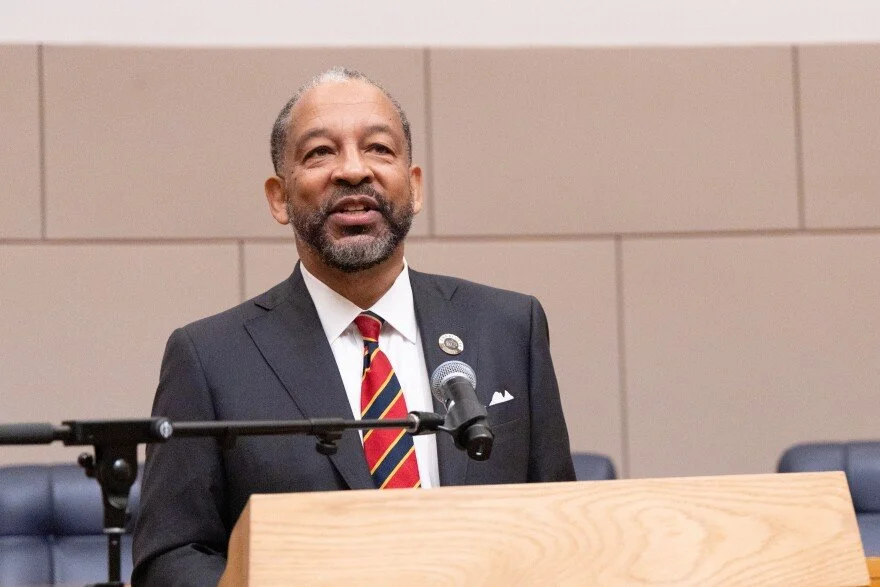
Rob Harrington, Mayor of Charlotte
In the official recording of that very brief interview, which Maveah shared with me, the Mayor shifts topics immediately after his statement. Apparently, he had no questions or concerns pertaining to how the CMPD investigated or how they reached suicide as a conclusion.
Vernon J. Gerbert is a retired Lieutenant-Commander of the New York City Police Department with over forty-four years of law enforcement experience. In 2013, as a homicide and forensic consultant, he published this article: The Seven Major Mistakes In Suicide Investigation.
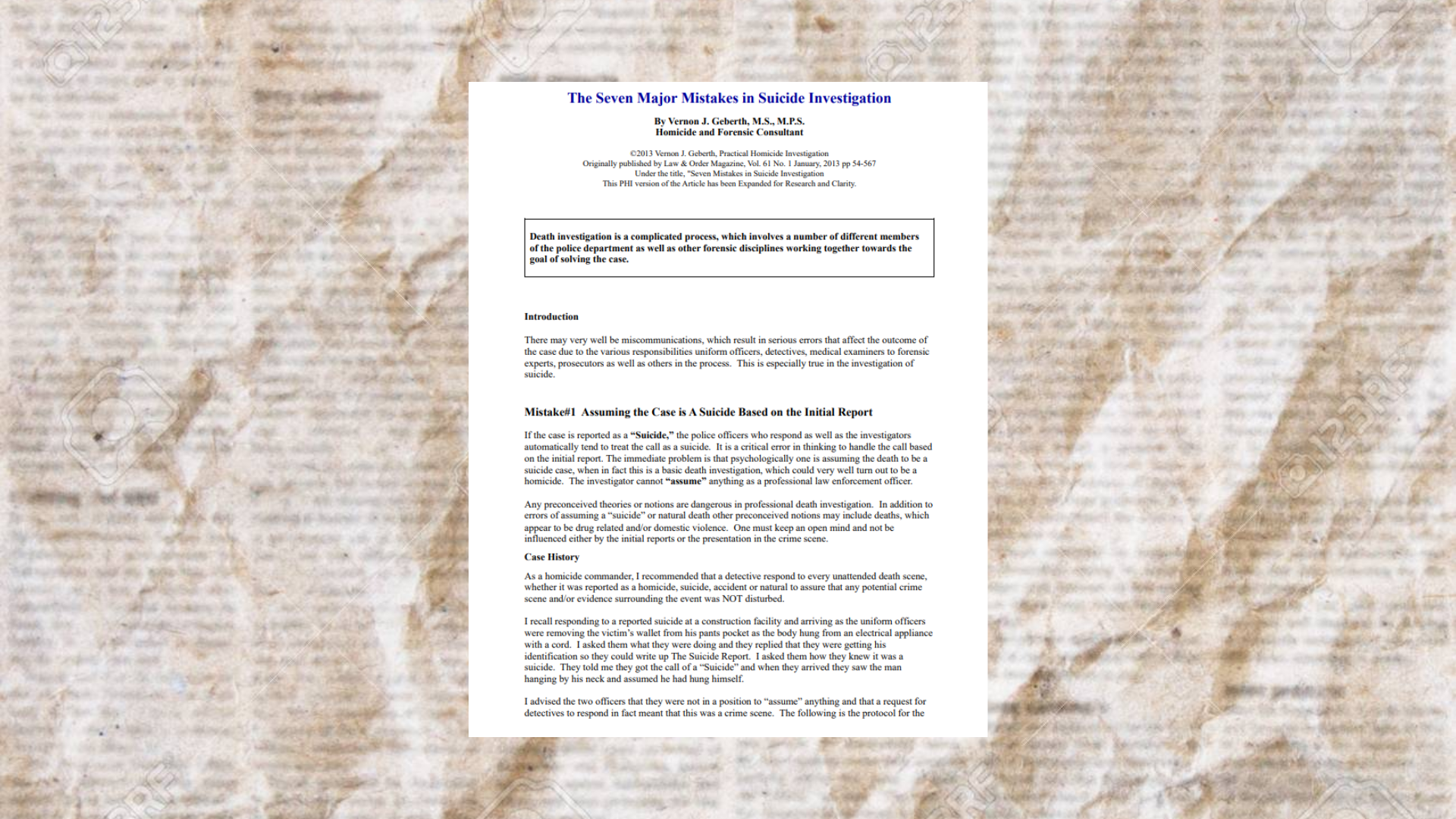
Essentially, when police officers immediately jump to conclusion and rule a death a suicide, not only does it result in the investigation’s expeditious closure, but it’s also completely lethargic. For example, in the 911 call to CMPD after Juliana’s body was found on the United House of Prayer church property, a man is heard saying, “It looks like a lady hung herself in one of the trees. It looks like she used a rachet strap to hang herself.” The operator responds that police officers are on the way.
Question: How was that call conveyed to responding officers? Was it delineated as a potential suicide? If so, did officers accept that preconceived notion and treat the case as such immediately upon arrival?
From “The Seven Major Mistakes In Suicide Investigations”:
“If the case is reported as a “Suicide,” the police officers who respond as well as the investigators automatically tend to treat the call as a suicide. It is a critical error in thinking to handle the call based on the initial report. The immediate problem is that psychologically one is assuming the death to be a suicide case, when in fact this is a basic death investigation, which could very well turn out to be a homicide. The investigator cannot “assume” anything as a professional law enforcement officer.
Any preconceived theories or notions are dangerous in professional death investigation. In addition to errors of assuming a “suicide” or natural death other preconceived notions may include deaths, which appear to be drug related and/or domestic violence. One must keep an open mind and not be influenced either by the initial reports or the presentation in the crime scene.
I recall responding to a reported suicide at a construction facility and arriving as the uniform officers were removing the victim’s wallet from his pants pocket as the body hung from an electrical appliance with a cord. I asked them what they were doing and they replied that they were getting his identification so they could write up The Suicide Report. I asked them how they knew it was a suicide. They told me they got the call of a “Suicide” and when they arrived they saw the man hanging by his neck and assumed he had hung himself.
I advised the two officers that they were not in a position to “assume” anything and that a request for detectives to respond in fact meant that this was a crime scene. My preliminary observations indicated that the “Suicide” was actually a homicide and that someone had effectively staged the scene to make it appear to be a suicide.”
How did investigators treat juliana’s case?
Vernon Gerbert said that when investigators hear suicide, they take short cuts. That appears to have been the thinking with Juliana’s case, because this “investigation” was shambolic and inept. For the past six weeks that I spent working on this story, I compiled findings of my own. They will be presented in four parts.
1. CMPD
2. The Church Property
3. Medical Examiner Office History
4. The Unmistakable Connection.
CMPD
On August 21, 2026, I sent CMPD a list of questions by email. These were my questions.
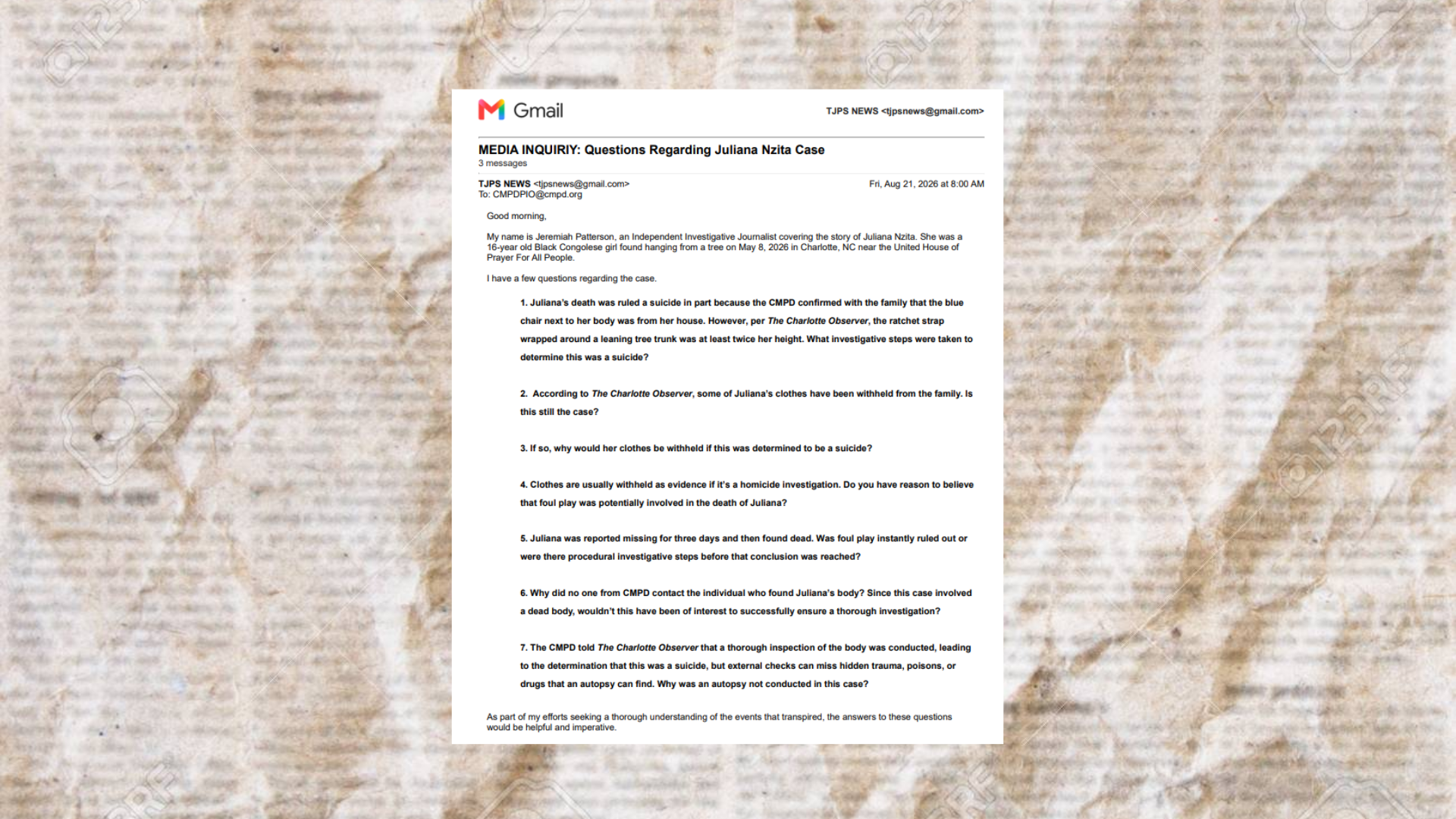
My Questions To CMPD
After sending my questions, they responded to call them. I spoke to the CMPD spokesperson by phone, and he did not answer any of my questions. He repeatedly asserted that this was a suicide, and no foul play was suspected. “Are you still planning to do a story on a suicide? There’s no reason foul play was suspected because it was ruled a suicide”, the spokesperson stated.
The CMPD spokesperson also wanted me to notify them before this story’s publication. I did not. This report was released without CMPD being notified.
The Church property
When I went to The United House of Prayer For All People, I had hoped to speak to someone or potentially review security footage, but there were no cars present. I did see multiple trespassing signs, which I’m told by Investigative Reporters Maveah Griffith and Caitlin McGlade, were put up after Juliana’s death.
I verified this with a Google maps search, next to the image I captured.
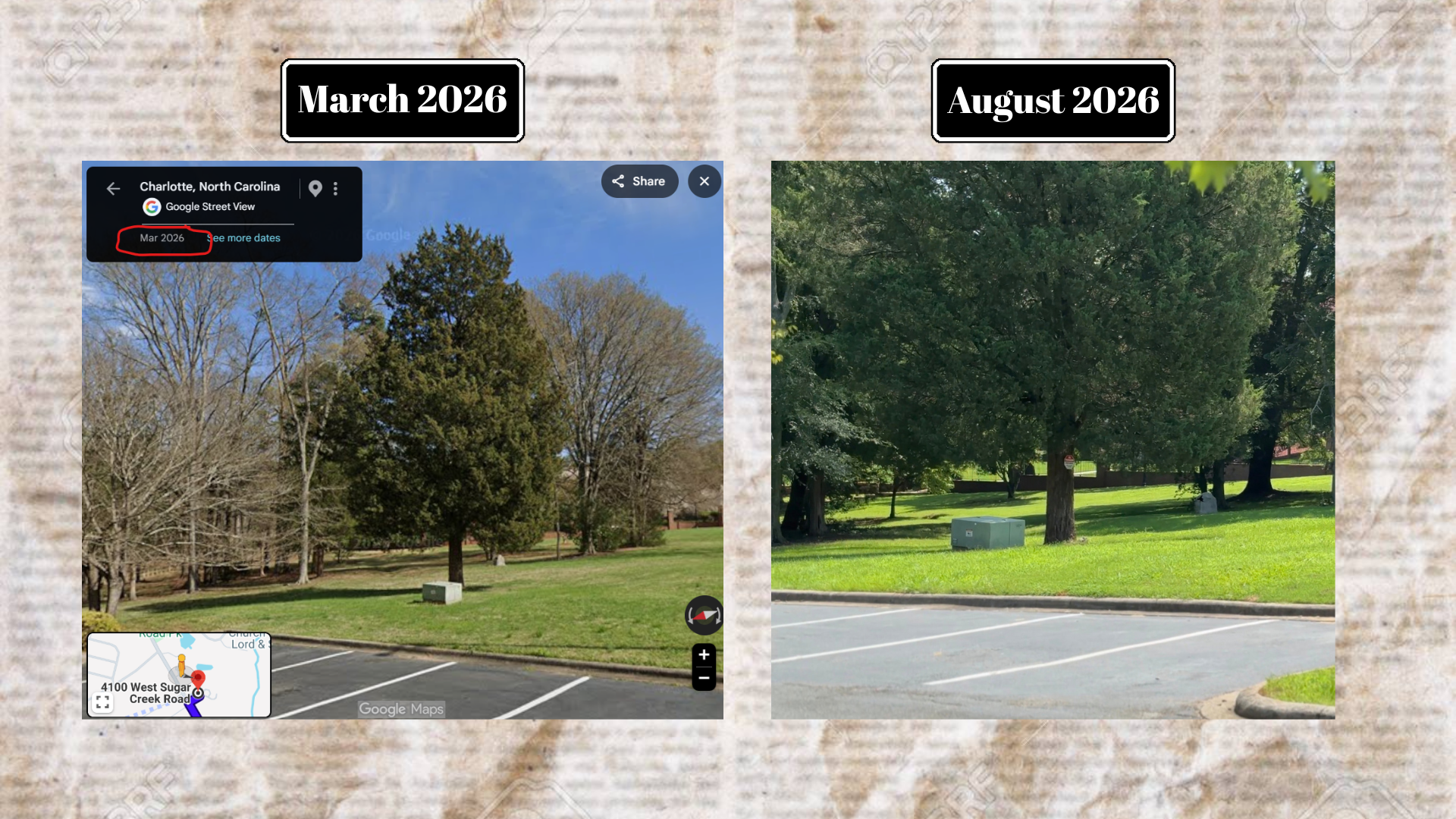
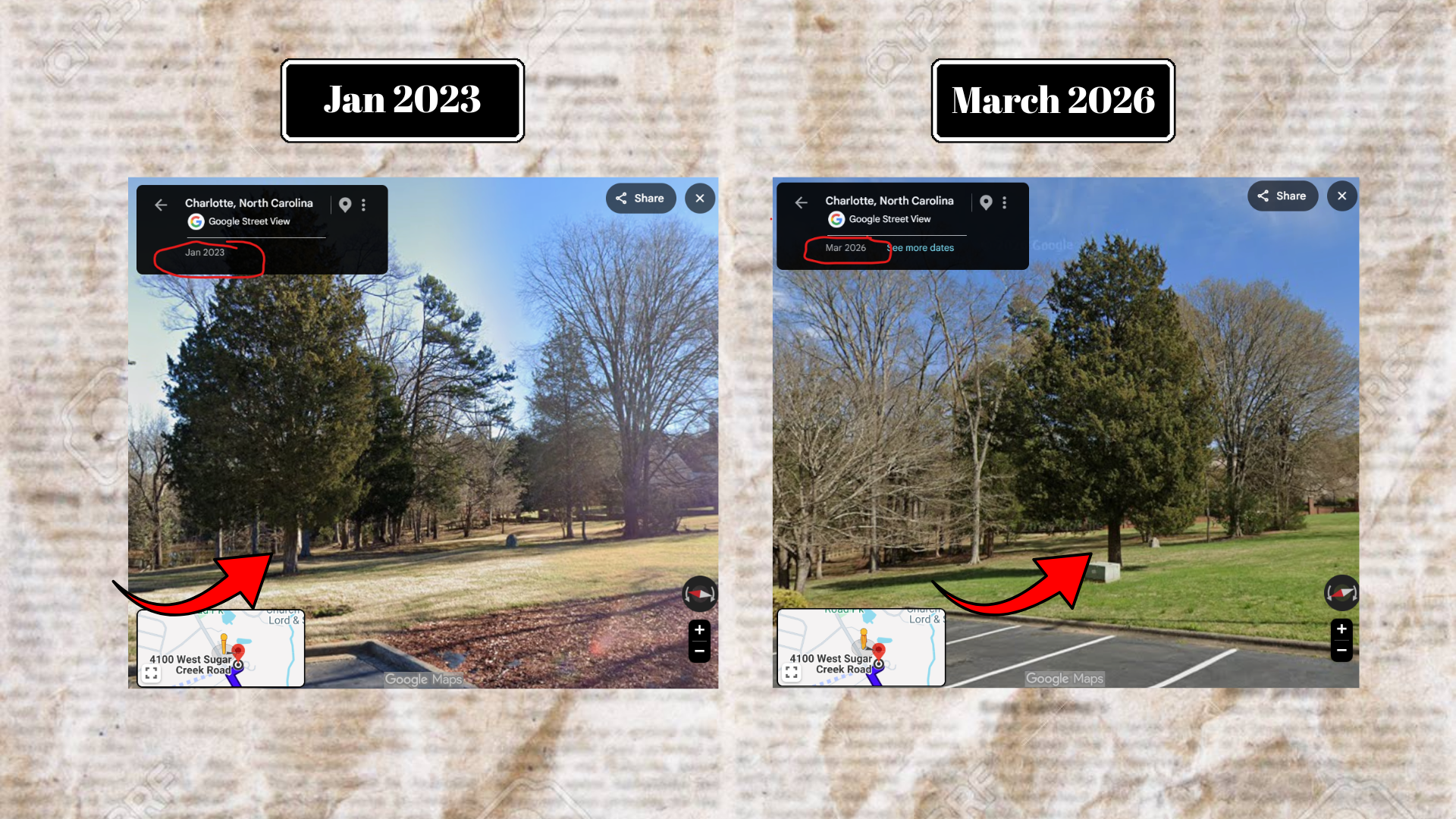
QUESTION: Why were those signs suddenly added?
Another thing that didn’t make sense is that CMPD said they reviewed security footage from the church and found nothing relevant.
These are images I took in August 2026 during my field investigative report. The camera on the left is positioned to capture vehicles or people entering the vicinity of the property. The camera on the right is positioned to capture the area in which I was standing and the grassy field next to it. The camera on the right is pointed in the exact direction where Juliana’s body was found on that tree.
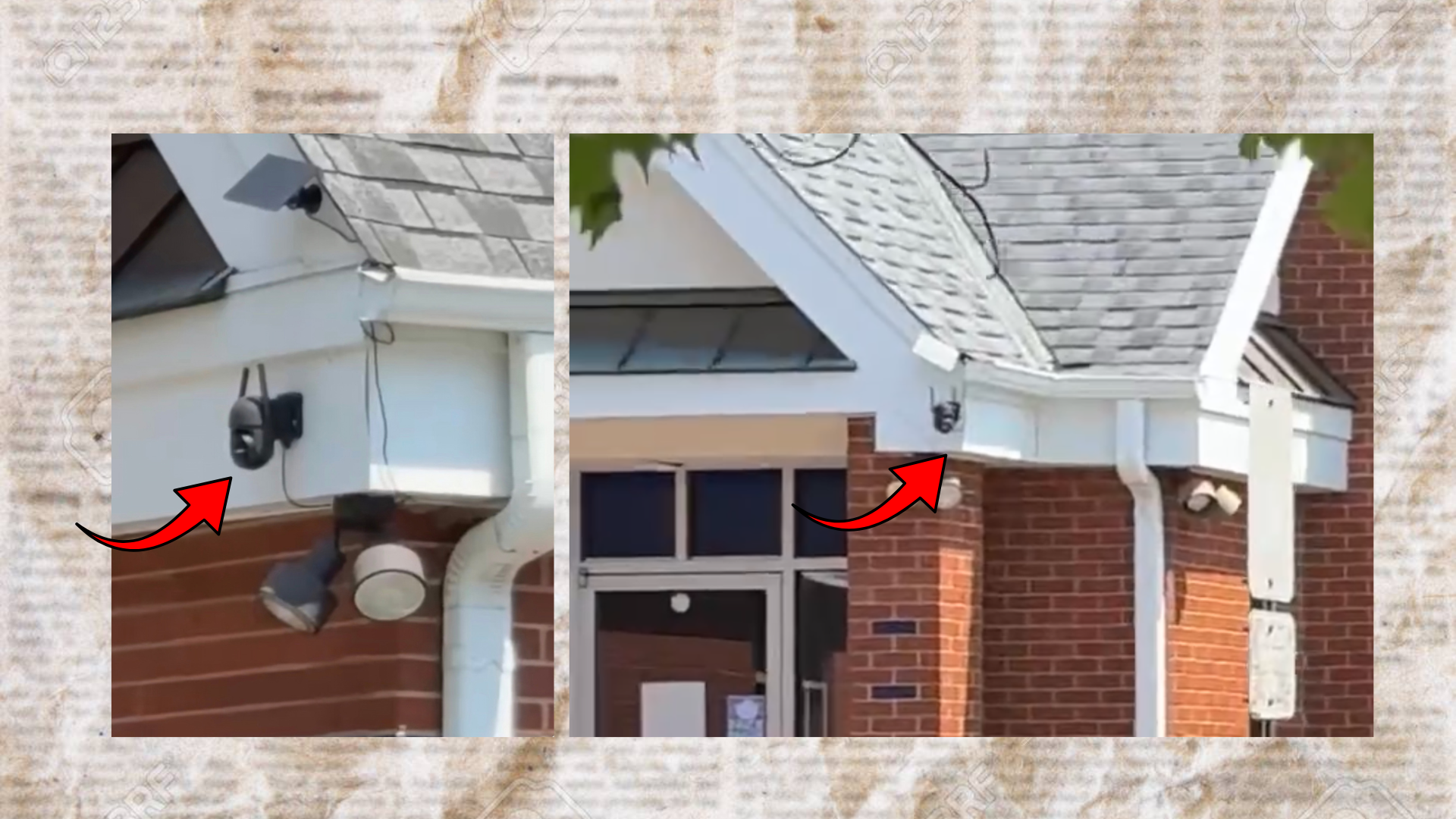
Cameras on The Church Property
Police said they saw nothing relevant. Both cameras 1 and 2 are black, solar powered, and have Atenas. What security camera sells those? Anran and Sehmua. What are the capabilities of those specific cameras? They’re omnidirectional, with wide rotation and visibility, and no blind spots. 355 degrees pan and a 90-degree tilt. It captures audio and night vision. For context, look at this footage from the Really Random Reviews YouTube channel of the Anron Solar Power Camera.
Did you see its swiftness? The zoom, the attention to detail and objects. The very precise camera shots. If the Anron Solar Power Camera wasn’t the camera on the church property, then here’s the Sehmua’s camera footage from the Macro Matrix YouTube channel.
Two of these cameras are located on the right side of the building, adjacent to where Juliana’s body was found. How was no relevant footage captured at all? That does not add up. There are also numerous flood lights on the property which are sensitive to any sudden movements.
Juliana and her family had no connection to this church at all. How did she get there and was she murdered somewhere else, and staged on that church property to make it appear to be a suicide? The church property sits on a large piece of land and there’s a large body of water behind the church that I was recording next to.
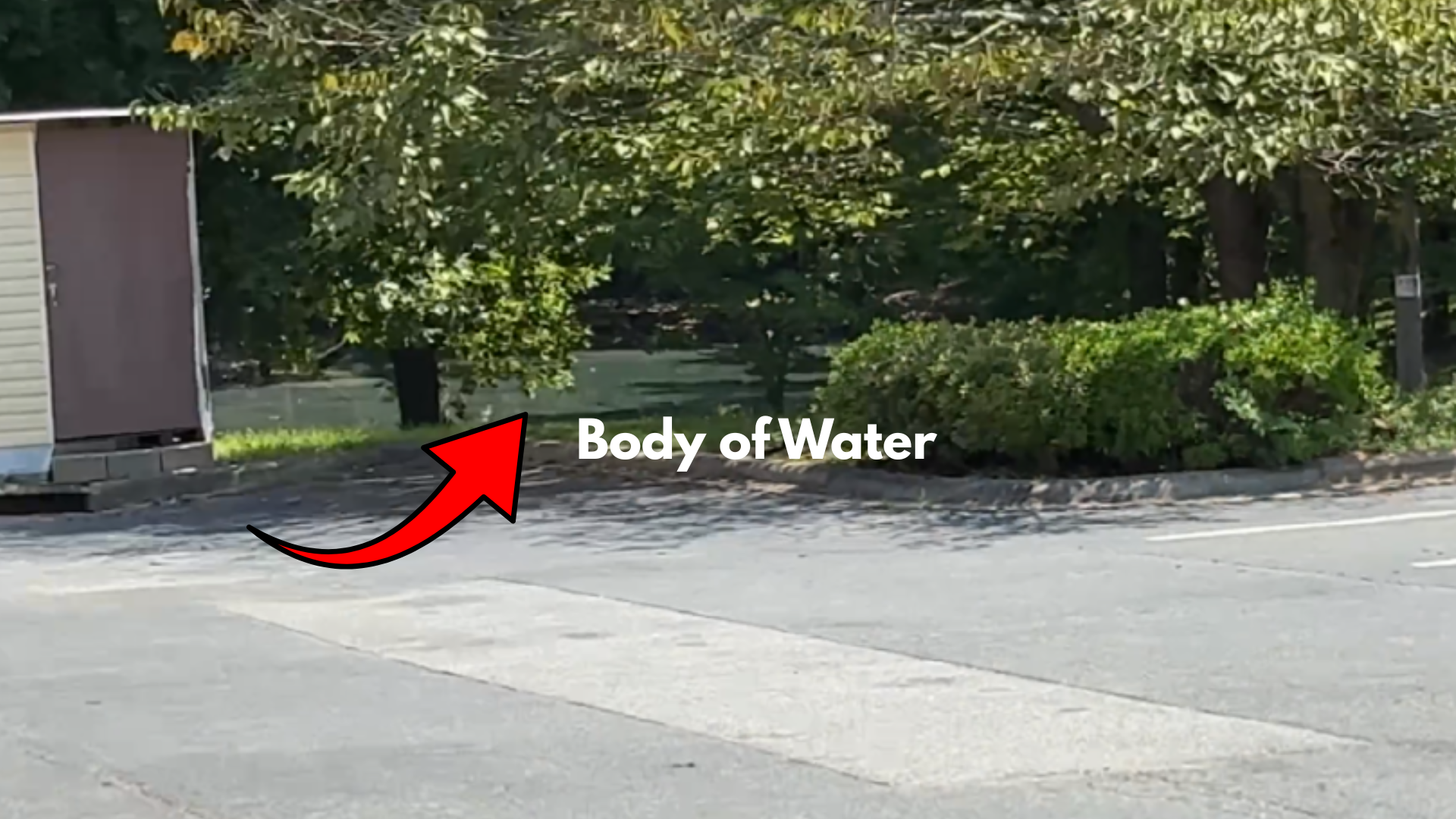
Body of Water on Church Property
Officers never found Juliana’s phone. Did they search the surrounding grounds or the body of water for her phone or any other essential material that could be relevant to this investigation? Did such an extensive and formal search transpire, and if not, why? Was this immediately determined a suicide upon officers’ arrival and nothing else was done? These are the kind of questions CMPD would not answer. Nonetheless, they’re integral to understanding the suicide ruling. How did CMPD arrive at that conclusion and so quickly?
Medical Examiner Office History
The medical examiner’s office received the body of Juliana Nzita and ruled her death a suicide. How did they reach that conclusion and what information did they rely on? I did reach out to the medical examiner’s office for the autopsy report, since it was a visual autopsy, and did not receive a response.
However, what I found in my research is that the Mecklenburg County Medical Examiner office has history of relying on CMPD for the determination of cause of death. In 2014, The Charlotte Observer published a five-part investigative series, exposing how the Mecklenburg Medical Examiner Office operates. The report found that, “examiners regularly close cases without following recommended practices.”
2014 Charlotte Observer Investigative Findings:
“They don’t go to death scenes in 90 percent of cases they investigate. In one of every nine deaths, they violate a state requirement to examine the bodies. But the state doesn’t require examiners to get training and rarely disciplines them when they break the rules. When a medical examiner gets it wrong, challenging the ruling can take years and cost families thousands of dollars.”
“If a person dies in mysterious circumstances, one of the state’s roughly 350 medical examiners is called to investigate. The state recruits medical examiners for each county by canvassing hospitals or placing ads in newspapers. The state’s chief medical examiner can appoint nurses, coroners, physician assistants and paramedics.”
“But most medical examiners are full-time doctors who perform death investigations on the side. The state requires no investigative training, provides little equipment or guidance and pays just $100 per case. It pays them no mileage. By comparison, North Carolina pays transporters $90 – plus additional money for trips longer than 40 miles – simply to move the body.”
“The average state medical examiner system spends $1.76 per capita on its death investigation system, according to a 2007 survey by the National Association of Medical Examiners (NAME). In 2013, North Carolina spent less than half that – about 84 cents per capita. A state guideline instructs in bold letters that they “must personally view every dead body” in cases they accept. But often they skip the inspection and send the bodies on to funeral homes for burial or to forensic laboratories for autopsies.”
This investigative report from 2014 ended with experts urgently calling for North Carolina’s system be overhauled. Faulty or rushed examinations led to missed trauma or injuries, such as failing to notice several stab wounds on a body initially written off as a car crash. “Homicides are going to get away from them”, said Aaron Hearn, a Forensic Investigator in Maryland, when speaking to The Charlotte Observer.
In 2025, the North Carolina state legislature passed a bill that shields medical examiner records from being divulged, specifically for journalists like myself.
NC Local reported, “Starting October 1, 2025, SB 429 exempts autopsy and investigative reports tied to criminal cases from public release until the case is closed, a move media lawyers and press advocates say undermines transparency and public accountability.”
When I reached out to the medical examiner’s office last month requesting information and Juliana’s autopsy, it was four months after the investigation was closed. But still, I did not receive anything.
For the record, there are several historical examples in the past of coroners and medical examiners colluding with law enforcement to rule Black lynchings “suicide” to protect someone they knew and wanted to protect from prosecution. This still happened even if the lynching was a public spectacle. That is not fiction, speculation, or a myth. It is a fact and one that we cannot dismiss when we’re talking about the consistent hanging deaths of Black people all over the nation.
The Unmistakable Connection
On March 16, 2022, George Tompkins, a 19-year-old Black man living in Indianapolis, Indiana was found brutally lynched inside Riverside park. His body was found hanging from a sapling in a wooded area of the park with a rope around his neck and his hands tied to the tree. White police officers and authorities disregarded evidence of foul play, including George’s bound hands and officially ruled his death a suicide, preventing a full investigation.
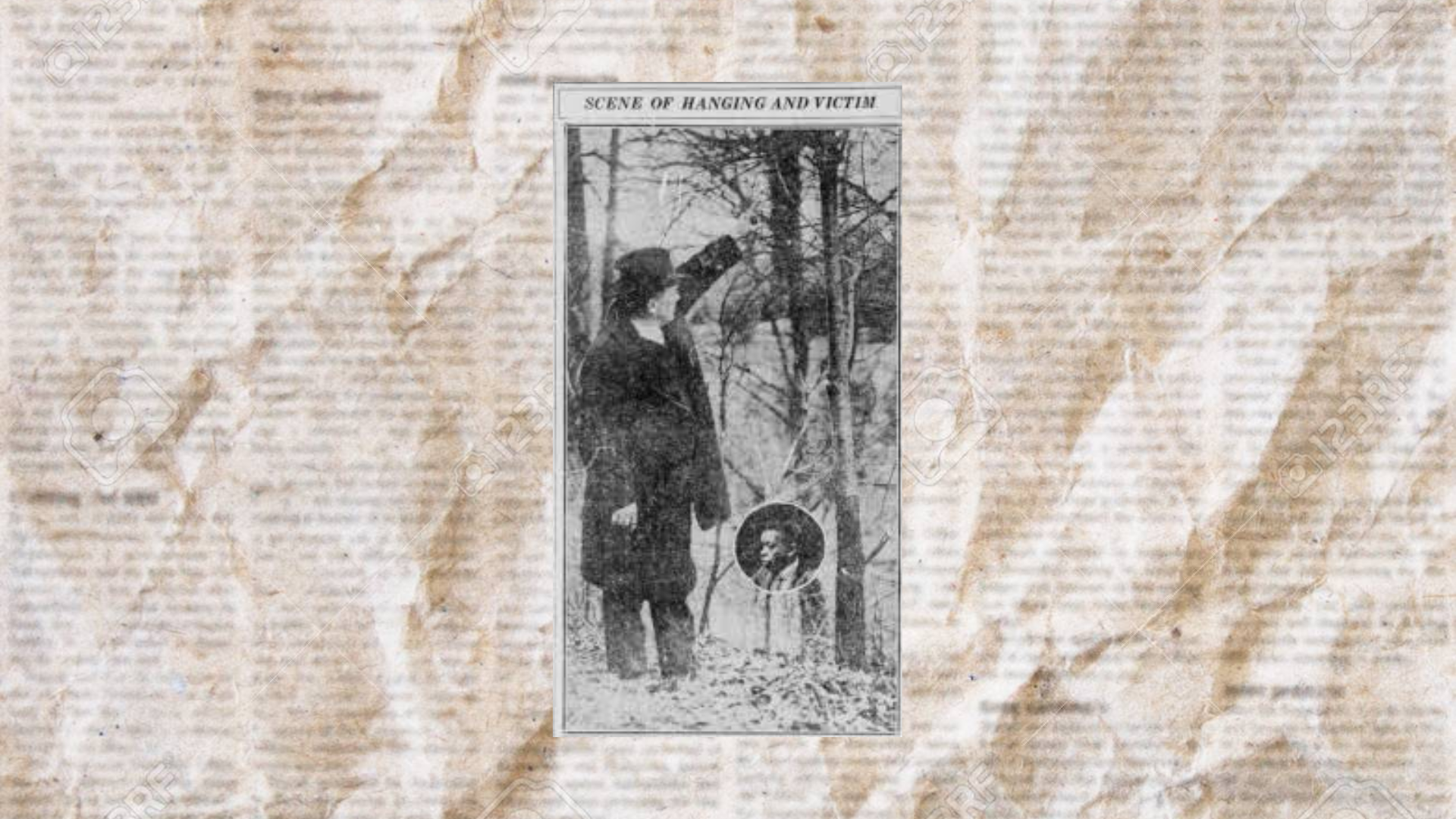
Site where George Tompkins Was Lynched In 1922
This suicide ruling happened despite the words of the Marion County coroner, who after viewing the body said, “There could be no question that the man had been murdered, and his body then tied to the tree.” He continued, stating that George was “dead or almost dead when he was hanged.”
The Equal Justice Imitative wrote, “He believed Mr. Tompkins had been strangled and that his attackers had bound his hands and dragged him to the sapling—leaving his body as a “warning” to other Black community members, according to a local newspaper.”
This was in 1922. George Tompkins was lynched, but his death was ruled a suicide. A century later, 100 years after he was lynched, in 2022, the Marion county coroner reexamined the case at the request of the Indiana Remembrance Coalition and after looking at the evidence again, issued a revised finding that George Tompkins was murdered.
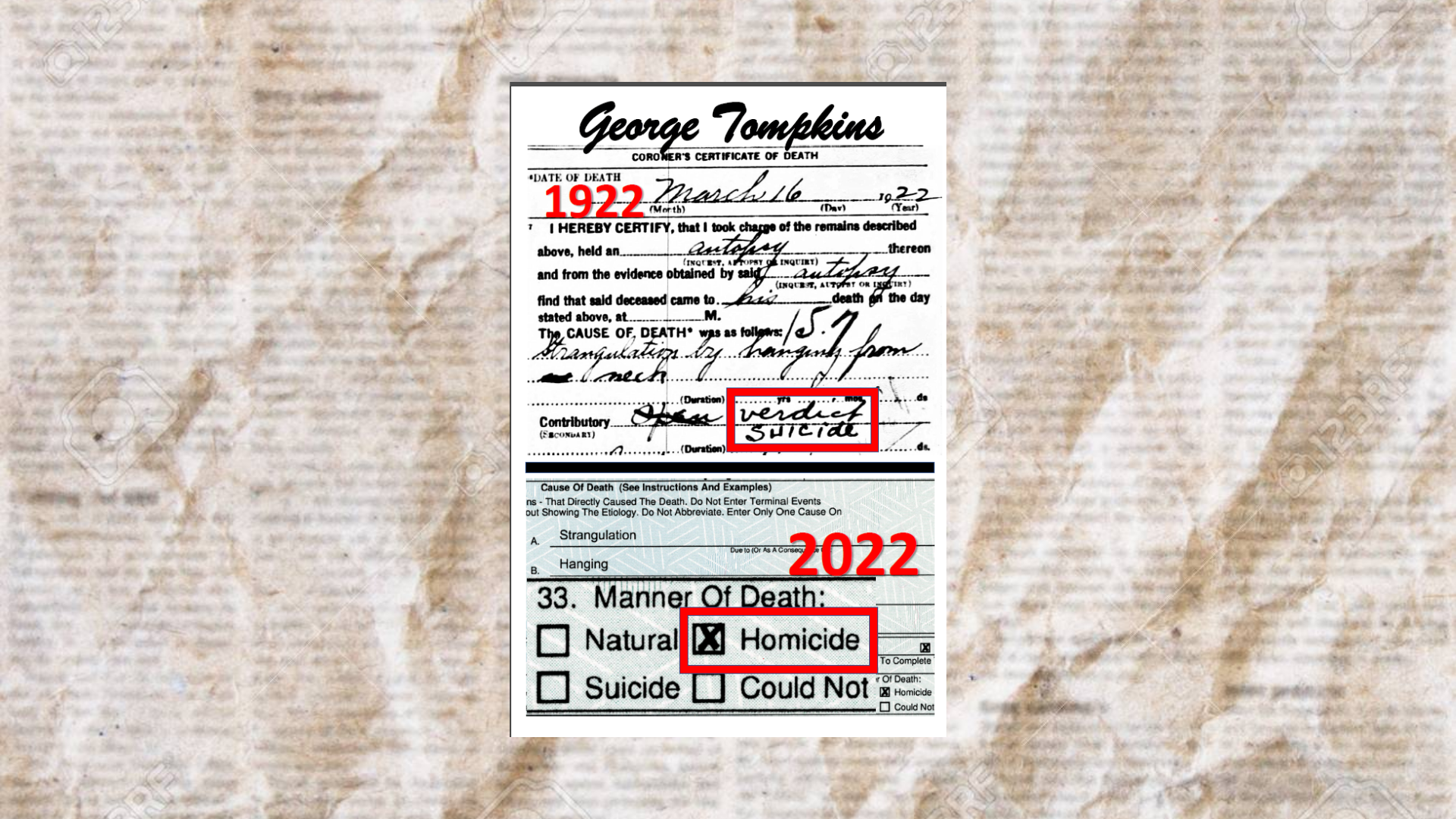
Original and Revised Death Certificate of George Tompkins
Upon this news, in 2022, the city of Indianapolis issued a formal apology, and a historical marker was established to honor and tell George’s story. But it’s a stomach turning feeling still, right? Because, on one hand, finally there has been an acknowledgement of the lynching, and this now is reclassified as a homicide and not a suicide. But on the other hand, what’s enraging is that it took a century and the people who killed him not only escaped justice and accountability here on Earth, but they got to live out their lives, while George’s stopped at only 19 years old.
That would not have been the case if white supremacy wasn’t so profusely ingrained in the foundation of every single institution and system of power in the United States. But because it is, they operated like that Black life did not matter and that he was utterly disposable and probably did it to himself. They don’t even care to find the truth or use the extensive resources of the justice system when it comes to Black lives.
64 years later, another precious 19-year-old Black teenager named Keith Warren was found hanging from a tree in Silver Spring, Maryland. This was on July 31, 1986. The Montgomery County Police Department ruled his death a suicide within 21 minutes. Authorities did not order an autopsy or a standard thorough medical examination, and his body was released to a morgue for embalming the same day.
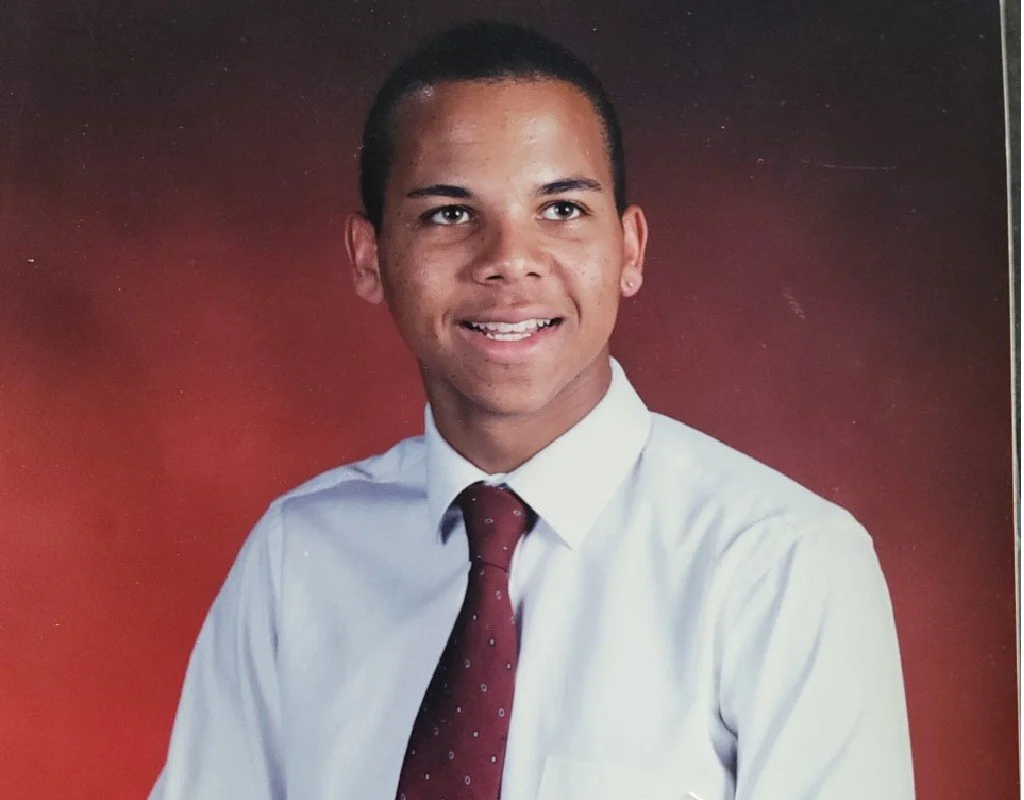
Keith Warren
Keith Warren was embalmed before an autopsy could even be performed or his was family was fully notified that he was dead. When Keith’s body was found, his feet were touching the ground, and his body was in a sitting/standing position. It is obvious to anyone with common sense that this was not a suicide. He was lynched.
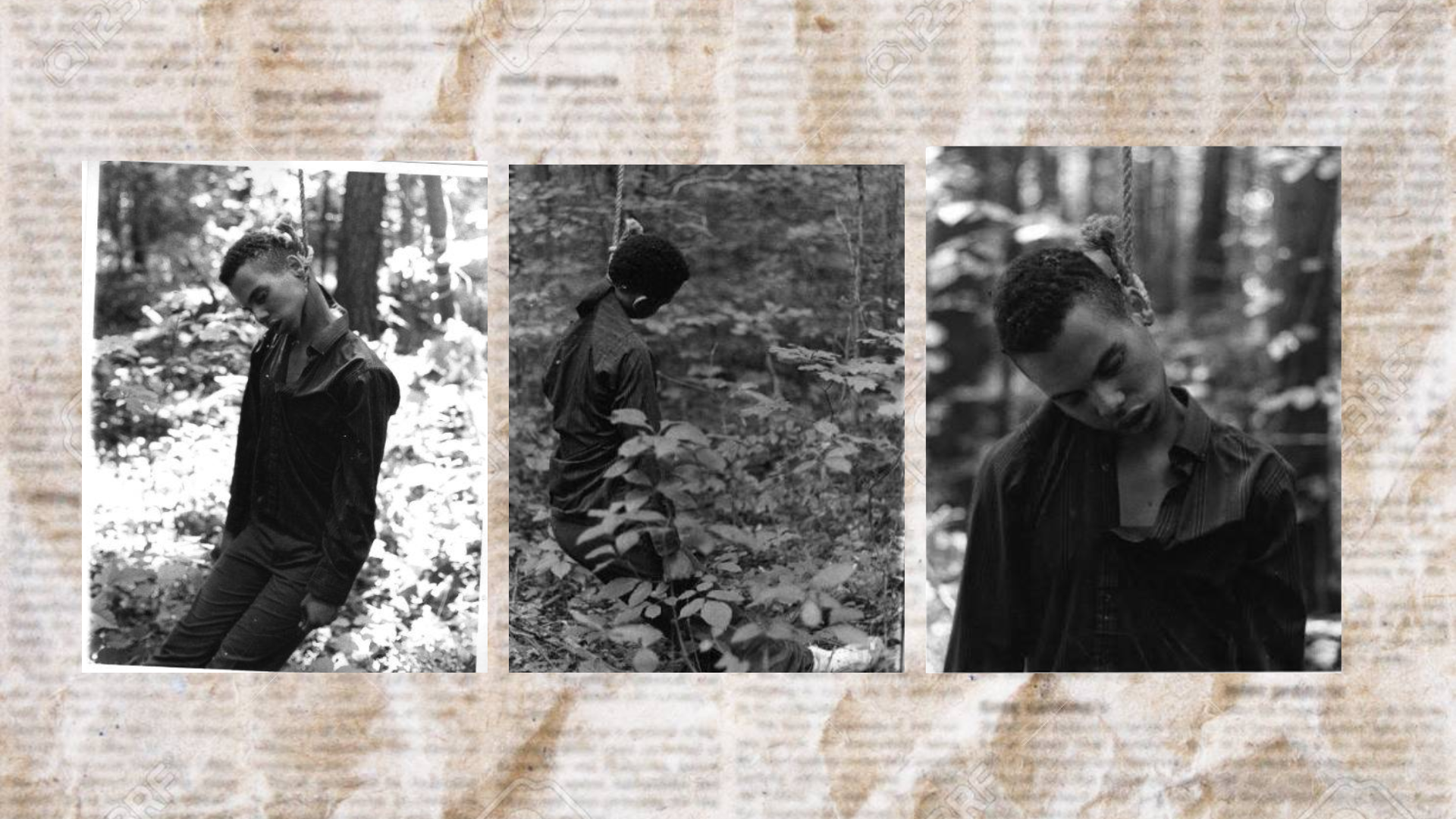
Crimes Scene Photos of Keith Warren, 1986
How could he have done that to himself? How is that a suicide? And the entire manner in which law enforcement moved is overtly and conspicuously a cover up.
Keith’s family pursued the truth and justice for years, until finally 2 years ago, in 2024, the Chief Medical Examiner for Maryland officially changed his cause of death from suicide to undetermined. How many more years will it take for it to be revised again and check the homicide box off just like George Tompkins? The family is still pursuing justice to this day.
I will be doing a documentary report on Keith Warren next year.
The images you’re about to see, to my knowledge have never been seen publicly before. They are disturbing and heartbreaking, but you need to see this for context. Below is the unfiltered photograph of Juliana Nzita. I have covered her face out of respect and decency.
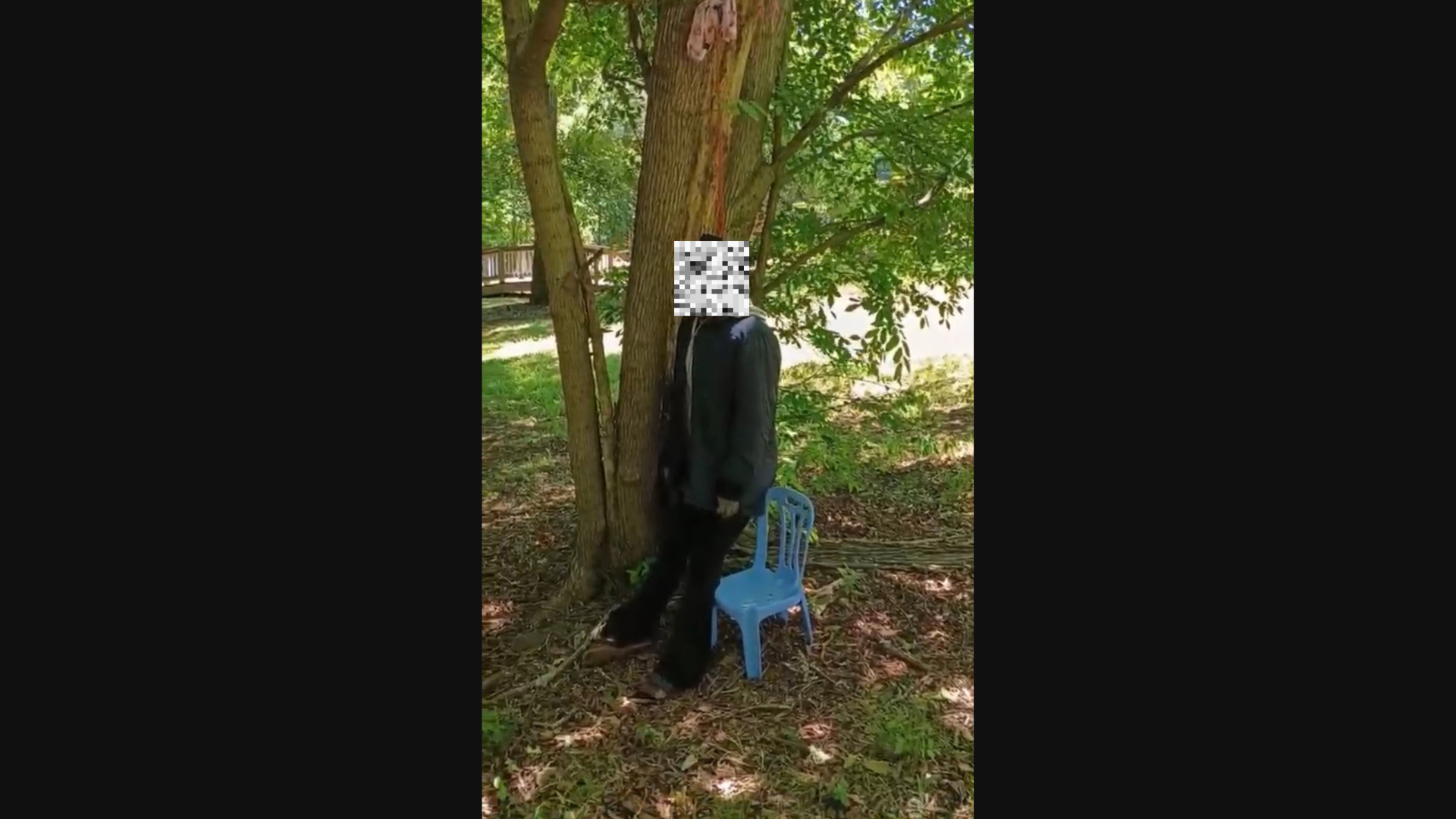
Image of Juliana Nzita body (Captured by Kenneth Tolbert, who discovered her body)
How is that a suicide? How did she tie the rachet strap perfectly above her wrapped around a tree branch she could not reach, even if she was standing on the blue chair next to her?
These are a side by side images of Keith Warren and Juliana Nzita. That is exactly identical and hauntingly so.
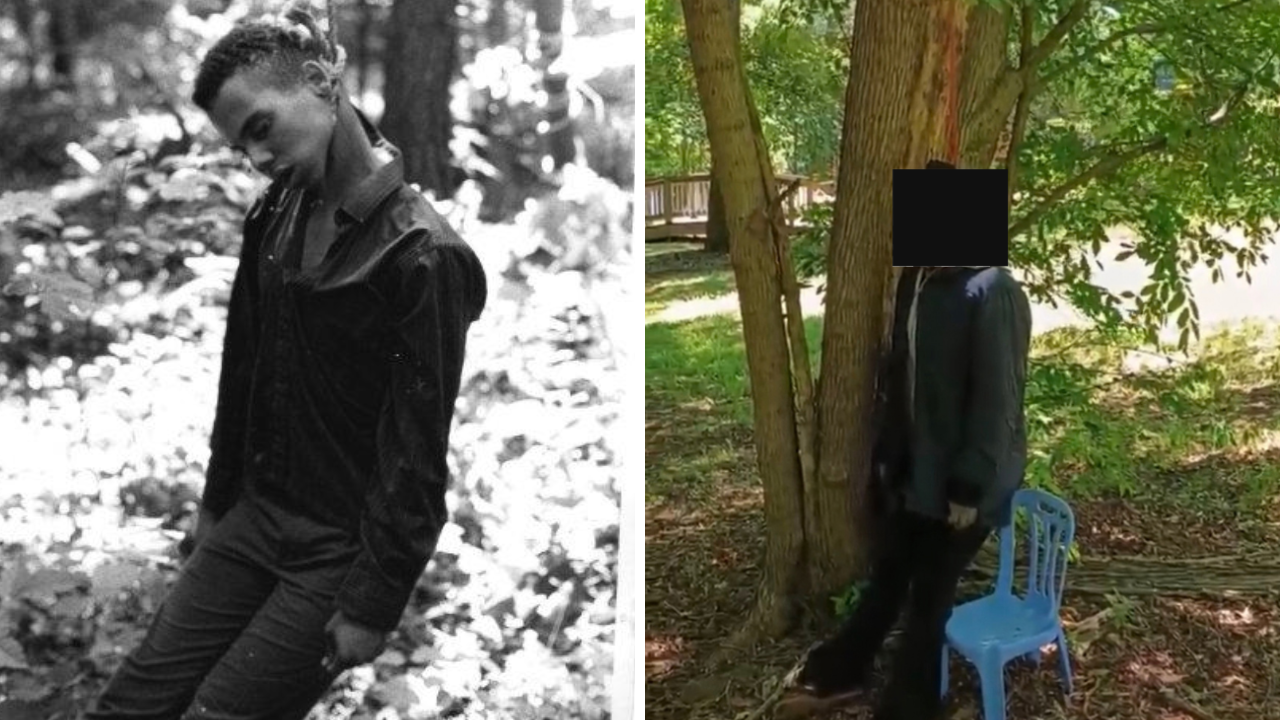
Keith Warren (Left, 1986), Juliana Nzita (Right, 2026)

Keith Warren (Left, 1986), Juliana Nzita (Right, 2026)
After doing extensive research, interviews, and assessing this unmistakable connection, I believe that Juliana Nzita was lynched, just like George Tompkins and Keith Warren. The Charlotte-Mecklenburg Police Department failed to conduct a proper investigation, leaving the community in the dark with no transparency or updates. There in unequivocally a sinister reality in Juliana’s case, and the lack of transparency from the CMPD supports this sentiment. A 16-year old Black girl was found hanging from a tree on the grounds of a Black church, and it’s ruled a suicide immediately. No one saw anything? Panoramic solar security cameras failed to capture footage? This conclusion should be vehemently rejected.
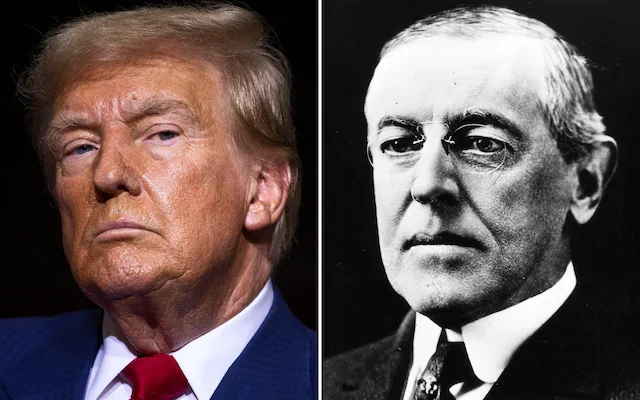
Donald Trump and Woodrow Wilson, Stanchly White Supremacist Presidents
Juliana’s death comes at a time when the Trump administration holds power. This is the most white supremacist Presidential administration since Woodrow Wilson, infused with unmitigated hate and vitriol for immigrants and minorities. The xenophobic rhetoric Donald Trump spouts and the actions perpetuated by the administration are violent, dehumanizing, and nefarious. The President and his official’s words have incited violence before, with many racist individuals feeling immune from criminal prosecution or accountability for their actions.
Furthermore, the U.S Department of Justice’s Civil Rights Division, which began in part, due to lynchings in the U.S, has been gutted by the Trump administration, as part of their evisceration of DEI. I covered this in a report last year.
I began The Cardinal Chronicles, because of what our country is experiencing again right now. The unvarnished truth matters and that is a mission each of us must take on. We’re obligated to answer that unmitigated devotion to pursue truth, accountability, and justice for every injustice, immorality, corruption, hate crime, and lynching, we see. The time for silence and compliance has never been appropriate, and most certainty is not now.
I implore you, do NOT let Juliana’s story die. Make persistent and perpetual efforts to effectuate change. Educate yourself, mobilize, and use your voice & your vote as your greatest repudiation to the diabolical, intellectually decrepit, and woefully unskilled actors eviscerating our rights.
For my interviews with Investigative Reporter Maveah Griffith and Charlene Henderson, the Chair of the Historic Hidden Valley #82 of the Mecklenburg County Democratic Party, please watch the special video report available on my YouTube channel.
